In the 1960s Had an Art Set That You Peeld the Numbers Off and Sprinkled a Velvet Type Substance

Without a doubt, blackness-velvet painting lives up to its reputation as the pinnacle of tackiness. You could point to any number of cheap, poorly done images of Elvis, scary clowns, matadors, "Playboy" nudes, and strange unicorns sold to American tourists by Mexican painters starting in the '50s. Only when velvet collectors Caren Anderson and Carl Baldwin look at these pieces, they see something else.
"Most velvet paintings are things that somebody wanted to pay coin for, just sometimes you call back, 'Gosh, what is it?'"
Staring at a black velvet painting makes you feel "like you're coming out of the womb," says Anderson, who co-wrote the 2007 volume Black Velvet Masterpieces with Baldwin. "Information technology could likewise be described as if someone is walking toward you from a nighttime corridor. Either way, you're in this dark place, and then things pop out at you."
They take an air of mystery, agrees Baldwin, who's besides her partner at the Velveteria museum, which volition reopen in Los Angeles as the Velveteria Epicenter of Art Fighting Cultural Deprivation on Dec. xiii, 2013, well-nigh four years afterwards the original location in Portland closed. "The light out of the darkness is really what it is," he muses. "It's a powerful medium. Something almost it just grabs people by the brusque hairs."
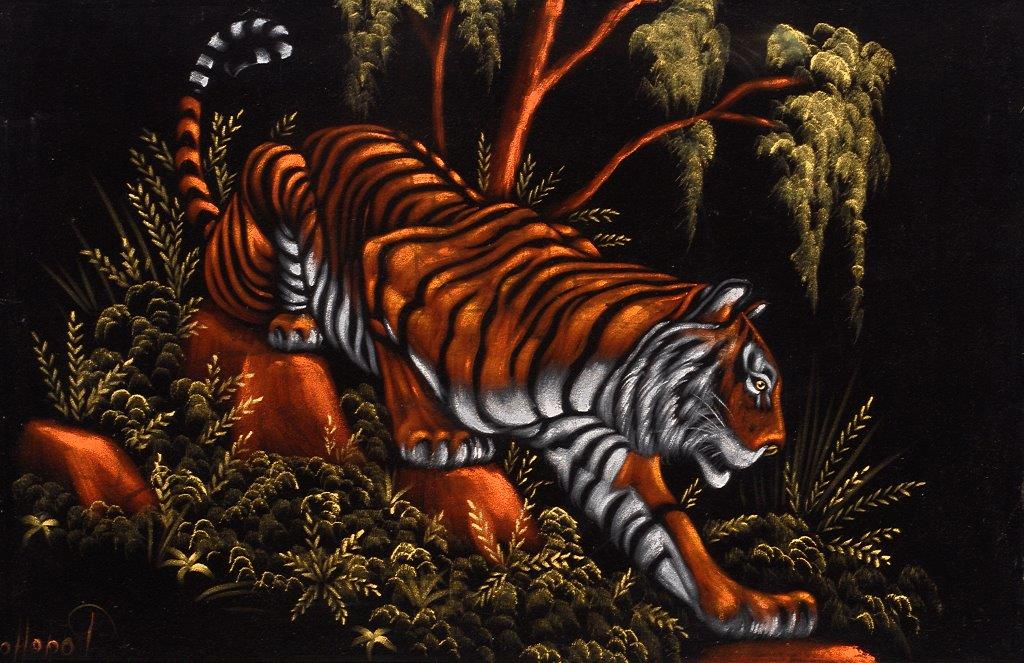
Peak: In the 1970s, matador paintings were popular with American tourists, who were looking for a souvenir that "felt similar Mexico." (Photo by Scott Squire from Blackness Velvet Art) Above: A tiger burns bright in a 1970s velvet past Pogetto. (From the Velveteria drove in Blackness Velvet Masterpieces)
And like any other art medium, velvet has its masters. Accept Edgar Leeteg, who created sensuous, tropical paradises in the '30s and '40s using a dry brush to delicately paint each hair. By the '60s, a Leeteg went for five figures, and if there weren't and then many replicas, they might still be worth a pretty penny.
Merely the tacky, flashy, and downright ugly paintings have stayed with the pop imagination—because, co-ordinate to folklore scholar Eric A. Eliason, nosotros need them to. In his 2011 volume Black Velvet Fine art, Eliason suggests that velvet paintings play an important role in Western culture as the anti-fine art, a fixed concept that people distance themselves from to bear witness they have skilful taste. Fifty-fifty though velvet painting references the same sort of pop-civilisation icons—such equally Marilyn Monroe, the Pink Panther, comic panels—as work by Andy Warhol, Jeff Koons, and Roy Lichtenstein, it lacks the detached self-sensation that allows Pop Art to be deemed gallery worthy.
"Why is black velvet dissimilar than any other medium?" Eliason says. "Canvass art has some crappy and tacky stuff, too. But the assumption is the minute you put an artwork on velvet, you've ghettoized it into this denigrated category that, I think, exists for a purpose. If black velvet didn't play the role that it has in the belatedly 20th century, something else would've emerged to take its place. This snobbery shows the ugly side of the fine-fine art world and upper middle-class aspirational sensibilities."

Two unicorns in dear bear upon horns in this painting from The Velveteria. (Courtesy of Carl Baldwin)
In "Black Velvet Masterpieces," Anderson tackles the long only patchy history of velvet painting, Baldwin contributes a more personal take, the story of how he fell in love with these artworks and Anderson at the same fourth dimension. It'southward the giddy peak of a funfair ride through his adventures in growing up in Southern California surrounded past surf rock, hot rods, head shops, boardwalk sideshows, and "Playboy" magazine.
"Information technology's a powerful medium. Something about it just grabs people by the short hairs."
For Baldwin, velvets were but office of the fabric of '60s Southern California, where he grew upwards a rascal on the beach. Even though he and Anderson went to the same loftier school in Balboa, California, well-nigh Newport Beach, Baldwin didn't take his "Coppertone Girl" on a date until they reconnected subsequently their 25-yr reunion. In 1999, Anderson visited Baldwin in Tucson, Arizona, where he endemic a house.
On their manner back from a day trip to the historic Wild Westward town Tombstone, they stopped at junk shop in Bisbee, where they saw, "a velvet painting of a kneeling woman with a large bluish Afro across from a picture of John F. Kennedy. It was one of those creepy velvet paintings; his eyes would follow you all around the store. The painting of the woman was 29 bucks and Kennedy was a hundred, and then we just went for the lady. We walked out feeling similar a million bucks."

Religious images have been painted on velvet since the Eye Ages. During the 20th century craze, Jesus was still the No. 1 figure seen on Mexican velvets, followed past Elvis, equally seen on the painting at right by Argo. (Photos by Scott Squire from Blackness Velvet Art)
This was the pair's get-go step downwardly what Baldwin calls "The Velvet Trail" that took him up and down the coast, effectually the Southwest, and over the edge to Mexico to unearth velvets and their history. Somewhen, Baldwin moved to Portland to be with Anderson, and the couple's obsession soon filled their home. At this point, they've collected nigh three,000, though just a few hundred of these will appear in the Velveteria at any one time.
"We've lost count of the velvets," Baldwin says. "We're just out of hand, totally insane. Yous know how it is in collecting: Y'all just can't finish. There'south no Betty Ford Center for it. We practice go a petty more than selective. I've got zip against the Lord, just we're getting style too many Jesuses. Still, if it's a expert i, we've got to go it."
Like Baldwin and Anderson, Eliason, a professor of English at a Brigham Young Academy in Provo, Utah, is on a mission to evidence that black-velvet painting is museum worthy. He believes they should be classified as "folk art," because it is created past regular people with no formal art training. But scholars accept traditionally "gone after easy, low-hanging fruit like a well-played Appalachian fiddle tune or a gospel-choir functioning. So I had the thought, 'What would be the about difficult case to brand?' And immediately the iconic blackness-velvet painting of Elvis struck me. Of course, part of the fun of this challenge is playfully and gently poking a finger in the eye of my discipline for having overlooked this fine art form for so many years."

A giant cricket, Sky's Gate cult leader Marshall Applewhite, and Yoda hung near a room of religious fine art in Portland's Velveteria. (Via Velveteria.com)
For what it'due south worth, velvet is a difficult textile to pigment well. "Artists are oft secretive almost how they practice it. In the Tijuana and the South Pacific traditions, it's very much near using a light affect, which is hard to do," Eliason says. "They say it's easier to paint on sail until yous become the technique downward. Simply the thing that makes black velvet meliorate to work with is that you have the negative infinite and the shadows already at that place."
"The One thousand.I.s were teenagers, man. Their taste was not that sophisticated when information technology came to fine art, so they went for the naked ladies."
What we know about the origin of painting velvet is spotty at best. The 13th-century merchant traveler Marco Polo recalled seeing painted velvet portraits of Hindu deities like Vishnu and Ganesh in India. Before long, Europeans were painting saints and allegories on the "sacred" fabric of velvet to hang in churches instead of woven tapestries. This practice was specially popular with Russian Orthodox priests in the Caucasus Mountains. In the 1500s, Spanish conquistadors brought velvet to the Philippines and Mexico, where peasants in Jalisco created the custom of painting on velvet skirts and party dresses, which modern-day Mexican painters often cite as the roots of their tradition.
The road to mass-produced velvet paintings might have been paved past Victorians, when Francis Townsend'due south concept of "theorem painting" became a hobby for middle-class ladies in England and the United States. This paint-by-numbers-type action involved using stenciled patterns and brushes to paint pleasant things likes notwithstanding lifes, flowers, and pretty landscapes onto velveteen, a cotton fiber velvet imitation. Hand-painted velvet artworks, of familiar images such as scenes from "King Lear" or replicas of famous paintings like Georges de La Tour's "The Fortune Teller," were starting time mass-produced and sold in the United states of america past the New York-based FAMCO, or French American Manufacturing Company, in the early 1920s.
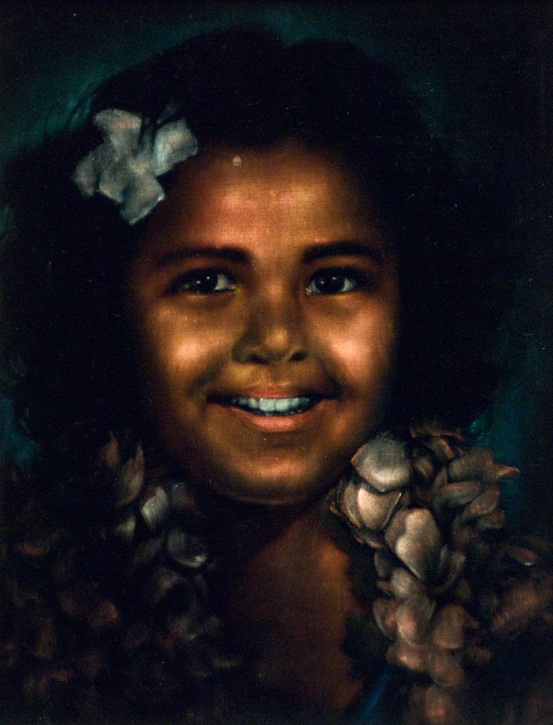
An Edgar Leeteg painting of a Tahitian child. (Courtesy of Brigham Young University Art Department Drove)
Just what we think of as the modern tradition of velvet painting started with a scoundrel named Edgar Leeteg. A sign painter who was hit hard past the Depression, Leeteg went looking for work in Honolulu, Hawaii, and then Tahiti in the 1930s. On a quest for sheet, he ended up buying velveteen because a local store wanted to go rid of it. Remembering the religious velvet paintings he saw in St. Louis as a child, he worked to master this challenging material, which would cause thick paint to clump and later crack.
Around Tahiti in the 1930s and 1940s, Leeteg was a well-known drunk and bar-fighter, who hitting on all the women using cheesy option-up lines, when he wasn't indiscriminately groping them. He painted flowers, landscapes, and children, only mostly the topless Polynesian beauties he bedded regularly and openly fetishized as noble savages with an Eden-esque innocence of their ain sex appeal. In the early days, he was often low on cash, and then he would trade his paintings for sandwiches and booze. Sailors and servicemen from the U.s.a., who no dubiousness enjoyed his images as an escape from Western prudishness, would purchase them for a few dollars.
But Leeteg was actually brilliant with the medium: He figured out how to paint thin layers with a almost dry brush, keeping the hairs of the velvet carve up. Using this layering technique, he was able to limit himself to seven colors, plus white, in oil pigment. Despite his talent at creating lush landscapes and lifelike portraits, Leeteg was shunned by museums and art critics. Already, velvet was considered a tacky medium, and painting on velvet automatically precluded an artist from being taken seriously by the fine-art world, which enraged Leeteg.

A moonlit scene of a man and his canoe by Edgar Leeteg. (Courtesy of Brigham Young University Art Section Drove)
Despite this, Leeteg's productivity never flagged, and he finished three paintings a month for 20 years, creating around 1,700 artworks in his lifetime. He ofttimes repeated himself and copied others. Seven of his about popular images were based on photographs that he didn't accept. Another one of his popular pieces was a replica of "The Head of Christ" past painter Warner Sallman, which Leeteg was forced to stop selling openly due to copyright police.
But Leeteg had his champions. In the '30s, a Utah jeweler named Wayne Decker toured Tahiti on a cruise. In a Papeete shop, Decker spied Leeteg paintings on the wall, similar to ones he'd seen in Honolulu, and ran back to the ship to tell his wife about them. Subsequently he left, beau passenger, Bob Brooks, the owner of the 7 Seas tiki nightclub in Hollywood, came into the store and bought all the Leetegs.
Drastic, Decker scoured the island looking for Leeteg until he found him, and when they finally met, Leeteg agreed to reproduce six of the paintings Decker had seen, including the famous "Hilo Hattie" and "Hina Rapa," for five aloha shirts and $200. Just those weren't enough for Decker. He deputed Leeteg to send him 10 paintings a year, and Leeteg fulfilled this agreement until his death in 1953. In the end, Decker had more than 200 paintings.

One of the many beautiful Tahitian women Leeteg painted. (Courtesy of Brigham Young University Art Department Drove)
Meanwhile, the 7 Seas bar, a competitor to Don the Beachcomber, was at the forefront of the burgeoning tiki-bar culture in the United States, which created an enticing, escapist fantasy of simple South Seas island life. Leeteg's maidens, surfacing from the murky blackness of velvet, made the perfect backdrop for such places, and before long, tiki-themed bars and restaurants all over the United States, like the Tonga Room in San Francisco, just had to have a Leeteg.
During Globe War Two, an influx of U.Southward. soldiers serving in the Pacific Theater discovered Leeteg'southward work while on shore leave. The buxom, idealized women appealed to the young servicemen, who painted pin-ups on their plane olfactory organ cones and leather jackets. Leeteg's popularity spurred a flurry or imitators, and Leeteg even taught his technique to a talented creative person named Charles McPhee, who married i of Leeteg's models, Elizabeth. The couple moved to New Zealand, where he painted her in a hugely popular series chosen "Tahitian Girl."
But peradventure the virtually instrumental abet of Leeteg's work was an eccentric former Navy submariner, "Aloha" Barney Davis, who opened a gallery in Honolulu after the war, specializing in South Pacific art and artifacts. Customers kept coming in, asking for Leeteg'due south velvets. When Davis finally tracked downwards Leeteg, he became the artist'south dealer, selling his paintings and licensing reproductions in his shop and all over the world. As tiki bars popped up in suburbs across the United States, the demand for Leetegs grew. Davis advertised Leeteg as the "American Gauguin" and tipped the press about Leeteg's wildest exploits in Tahiti. (In New Zealand, Leeteg's protegé McPhee became known as the "Velvet Gauguin.")
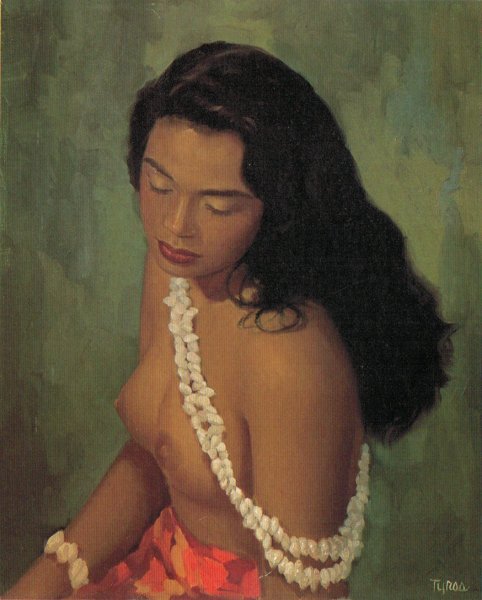
Ralph Burke Tyree'south "Local Girl," circa 1950, is an example of the Due south Pacific school of velvet painting pioneered past Leeteg. (From Don Severson's "Finding Paradise: Isle Fine art in Private Collections," via WikiCommons)
By the 1950s, demand for Leetegs was then loftier, the painter had a hard time keeping up. With his paintings were then selling for thousands of dollars, he congenital a vast estate he called "Villa Velour" in Cook's Bay, Moorea, for his mother, multiple wives, and children. When Leeteg learned he had a venereal disease in 1953, he went on a drinking rampage in Papeete and crashed his Harley-Davidson. The 49-yr-one-time artist died instantly.
Nostalgia for the tropical islands on the part of the men who served in World State of war II, and subsequent wars in Korea and Vietnam, ensured the continued popularity of Leeteg and his followers in the S Pacific schoolhouse of velvet painting. One such talent was Ralph Burke Tyree, who began painting velvets of Samoan maidens in the '50s. And when James A. Michener immortalized the late Leeteg in his 1957 collection of non-fiction curt stories, "Rascals in Paradise," calling him, "at least the Remington of the South Seas," Leeteg'due south popularity skyrocketed. Past the 1960s, an original Leeteg had sold for $20,000.
Thanks to Davis, velvet paintings became an essential office of the tourism manufacture in Hawaii, which became a state in 1959. When American artist Cecelia "Ce Ce" Rodriguez encountered a shop full of such velvet paintings in 1960s Honolulu, she was inspired to move to Hawaii and take up the medium. Lou Kreitzman sold her luxuriant artworks in his gallery and brought her paintings to be displayed in the Hawaiian pavilion at the 1964 World'due south Off-white in New York. For years, several Hawaiian resorts proudly featured her piece of work. But by the 1970s, the emergence of the Mexican velvet-painting industry killed the medium for Rodriguez, when even galleries in Hawaii stopped taking it seriously.

An advertisement for Aloha Barney's Davis Gallery featuring velvet paintings from Leeteg of Tahiti. "Hina Rapa" can be seen in the top left corner. (Via MuseumofWonder.com)
Despite the thriving postal service-war economic system, most Americans dreaming of far-away paradises couldn't afford a trip to Polynesia, not fifty-fifty Hawaii. United mexican states was the closest "exotic locale" for the American lower classes, and Mexican merchants were happy to play it up. In the 1950s, velvet paintings proliferated in tourist markets in cities all along the U.S.-Mexican edge, including Ciudad Juarez, a town simply across the border from El Paso, Texas, that was known as a place for Americans to ditch their Puritan roots and run amok.
"Ane person would pigment the pilus, the next person would practice the neckband, and the next person would do the rhinestones. The last person would do Elvis's profile, and so it'd exist done."
In Juarez, Juan Manuel Reyna was 1 of the first artists to realize the medium's potential when he bought a religious velvet painting of Jesus to restore in 1950. According to Blackness Velvet Masterpieces, he started painting his own works on velvet, and they were snatched up by tourists. In a 2004 "Houston Chronicle" article, Reyna told journalist Sam Quinones that in '60s and '70s, "a lot of people became velvet painters: housewives, students, unemployed men, everyone."
Some people believe that soldiers aircraft out of San Diego, California, brought velvet painting to the nearby border town, Tijuana, only Mexican artists will argue that their velvet-painting tradition began at home. Like Juarez, Tijuana, likewise known equally TJ, had a long reputation as a city of sin and curios, going back to the 1920s, when Prohibition sent Americans south of the border in search of booze, prostitutes, and gambling. In the 1950s, velvet paintings joined the ranks of bullwhips, switchblades, and firecrackers as tempting souvenirs offered by Tijuana vendors.
"Dorsum in the old days before Vegas became popular, TJ was the Las Vegas of the West Coast," Baldwin says. "Hollywood would go down in that location for the jai alai, the race tracks, balderdash-fighting, gambling, and all the other bad things. Tijuana was basically the hell on earth."

Tijuana artist Jesus "Chuy" Gutierrez took a photograph of a neighbor with a craggy face in the 1960s and painted him every bit a bandido. This paradigm as been replicated and altered hundreds of times by Gutierrez and his copycats. (Photo by Scott Squire from Black Velvet Art)
Originality wasn't a particular concern for Mexican velvet painters. If an image sold well, the painter would reproduce it over and over once again, while his competitors would also copy it. Mexican border artists borrowed liberally from the South Pacific school equally well every bit the Old Masters, photographs in magazines, and popular cartoons.
Co-ordinate to Black Velvet Masterpieces, Cesar Labastida was ane of the early Tijuana velvet painters in 1954, supplying local shop owners on Avenida Revolución with 40 paintings a week of matadors, Native Americans, Jesus, and celebrities, which the stores would then offer for $60 apiece. In the volume, Miguel Mariscal tells Anderson he started painting John F. Kennedy subsequently his assassination in 1963. "Not until celebrities died did people want these velvet images of them. Marilyn Monroe, James Dean, Jim Morrison, John Lennon," Mariscal explains.
But a living, breathing celebrity was even bigger than those. Moises Mariscal, in Black Velvet Masterpieces, asserts his father sold the start-always black-velvet Elvis, or "Velvis," from his Tijuana gallery in the '50s. In the volume, Miguel Najera says Elvis was where the money was in the 1960s and early '70s, earlier the singer'south untimely decease in 1977. Najera worked with Nicolo Pino, who, with his workers, churned out low-quality paintings of Elvis by the thousands.

To save fourth dimension, Mexican velvet painters would often take a moisture prototype and press it onto a fresh piece of velvet to create a lighter prototype to fill in. That'due south why so many velvet images accept mirror images floating around, as you can run across with these poodle paintings. (From the Velveteria drove in Black Velvet Masterpieces)
To make the process get faster, the creative person would lay a wet painting on a blank piece of velvet and press them together to create an outline for the side by side painting. That'due south why and then many velvet paintings have reverse images. Some other technique for getting the outline on the canvas included punching pocket-size holes along the lines of a drawing, placing the cartoon on the velvet, then dusting it with chalk or calorie-free-colored powder, and so that the chalk left a dotted outline on the velvet. (Sometimes you lot tin notwithstanding see role of the chalk outline on a velvet painting.) Images were also projected onto the velvet, or the painters would use techniques like airbrushing or screenprinting.
Because of this, some border painters had no artistic skills, but the velvet painters who have stuck with it usually accept a real souvenir, such as Najera, Tony Maya, Roberto Sanchez, and Nacho Amaro, perceived to be among Tijuana'southward best, according to "Los Angeles Times" reporter Sam Quinones. And Baldwin points to Daniel Guerrero in Nogales, Mexico, every bit a main of creating light in the blackness of the velvet.
No affair how much talent they did or didn't possess, early on Mexican velvet painters didn't accept the resources to concern themselves with artistry; they had to make a living. That's why images that sold well—Jesus, Elvis, panthers, cowboys, clowns, bullfighters, dead celebrities, naked women—were copied over and over again. It didn't thing if the paintings were done well or poorly, they sold the same. Mexican artists used cheaper acrylic paints and velveteen with a thinner nap than the velvet painters of the South Pacific school.

The child who had this clown in his or her room probably had a hard fourth dimension sleeping. (From the Velveteria collection in Blackness Velvet Masterpieces)
As well celebrities and wild animals, the subjects of the paintings were often based on American fantasies about Mexico, which is why they featured campesinos, matadors, low-riders, and stunning cactus-dotted landscapes. In Quinones' 2002 commodity "Velvet Goes Clandestine," Tijuana artist Jesus "Chuy" Gutierrez remembers taking a snapshot of a neighbor with a rugged face in the '60s and painting him equally a Mexican outlaw, or "bandido." This epitome was knocked off thousands of times and sometimes embellished with scars, cigars, eye patches, or facial hair.
Tourists bought black velvet paintings for their children'south rooms, ofttimes featuring clowns, unicorns, or cute kids and animals with big eyes and big heads. Paintings of dogs playing poker, based on 1903 ad C.M. Coolidge created for Brown & Bigelow to sell cigars, were popular with congenial societies and men's clubs like the Elks Lodge. Often Christians took their religious velvets of Jesus, Mary, or the Last Supper very seriously. The spirit of the ceremonious-rights motility was even captured and celebrated in velvets honoring Martin Luther King Jr. and Malcolm X.

Strange, alien-like children with huge eyes evidence up often on vintage velvets. (From the Velveteria drove in Black Velvet Masterpieces)
Other, less noble velvets reveled in vices and sophomoric humor. Children and devils were depicted sitting on the toilet, probably for display in the bathroom. Naked women with impossibly perfect bodies were a staple. "Dope fine art" historic drug civilisation, while psychedelic pieces were painted with Day-Glo colors to be used with black lights.
"About of them are things that somebody at some point decided that they wanted to pay money for," Eliason says. "But sometimes yous think, 'Gosh, what is information technology?' Things like a poor, fiddling girl with a hog olfactory organ and the dog that looks like information technology has stumps instead of actual legs. Information technology's merely like, 'Ahhh! What is that?'"
"Yeah, a lot of them were tacky, it's true," Anderson admits. "Simply Mexican artists painted what they thought we wanted or what people were ownership. We laugh at some of those bad ones but I've heard people say, 'Hey, I know people who still have them in their trailers.' And there are a lot of Mexican people here in California and other places, who've got their Virgin Marys hanging in their homes, and it's no joke."

The struggles of the civil-rights movement and its leaders, including Martin Luther King Jr. and Malcolm X, were captured in velvet. (Photo by Scott Squire from Black Velvet Art)
During the Vietnam War, tourist-market place black velvet painting also proliferated in Vietnam, Thailand, and the Philippines, specially in Angeles City, well-nigh the United States' Clark Air Forcefulness Base. In Black Velvet Masterpieces, Anderson says, "Wherever the U.S. armed forces went, velvet painting seems to have followed." A visitor called Suh Kwang Products Express in Korea and Vietnam produced round velvet paintings with large-eyed soldiers, often with tears in their eyes, in front of jungle scenery or helicopters.
"This snobbery shows the ugly side of the fine art world and upper middle-class aspirational sensibilities."
"During the Vietnam State of war in the '60s, all the G.I.'s would get out from San Diego, through Hawaii, and then to Angeles City in the Philippines," Baldwin says. "That was the R&R place they'd go to from 'Nam. Over the form of doing this research, I met quite a few guys who went to Angeles Urban center brothels. Information technology was just a wild, wild identify, thanks to all these young guys fighting in the state of war. And they were teenagers, man. Their taste was non that sophisticated when it came to fine art, so they went for the naked ladies. These guys would roll them up in their duffle bags and bring them back to the States."
Baldwin remembers a man who came by, offering them a whole bunch of '60s black-low-cal paintings, which Baldwin purchased for display in the museum. "Information technology's heavy stuff nigh state of war and drug usage," Baldwin says. "There'south this muscle-spring skeleton of a Yard.I. shooting up. He'south got the skull face and the Army helmet. And I go, 'Shit, that's Vietnam.'"

During the Vietnam War, these images of GIs as wide-eyed children by Suh Kwang Products Limited were snapped up by U.South. soldiers. (From the Velveteria collection in Black Velvet Masterpieces)
Despite all the street artists in Southeast Asia, United mexican states was where the truthful commercialization of velvet paintings flourished. In 1964, an American business owner Doyle Harden, who endemic a grocery-store concatenation in Georgia, purchased seven velvet paintings on vacation in Juarez. When he sold them at his stores, his profit covered the price of his trip. Later on that, he returned to Juarez regularly to haul back truckloads of velvets. In the early 1970s, he formed a partnership with Chicago business Leon Korol, to establish Chico Arts to distribute blackness velvet paintings to five-and-dime stores all over the United States.
In 1972, Harden built a block-long Chico Arts factory, or "maquiladora," in Juarez where he employed workers for circular-the-clock shifts that produced several thousand paintings a day, distributed to American gift stores, malls, mobile-domicile dealers, and motels. Each painter would work with one colour on his or her brush, and the painting techniques for each were highly guarded secrets, to discourage painters from opening their ain businesses.
"The paintings would slide along these boards that the mill owner had constructed," Eliason says. "Ane person would paint the hair, the next person would do the collar, and the adjacent person would do the rhinestones. The terminal person would do Elvis's profile, so it'd be done. And so they'd slap the name of the patron or the factory owner on it, and out information technology'd get."

This devil surround past vices is a part of the black velvet subgenre known as "dope art." (Photo by Scott Squire from Black Velvet Art)
Unfortunately, the workers suffered from breathing in the toxic fumes from the black leather dyes used to create outlines and embrace up errors. In spite of that, the formerly impoverished manufactory painters were often happy to have the work, which allowed them to buy houses and cars, much like the artists working for themselves in Tijuana like Jorge Avalos. By the 1970s, successful velvet painters lived large, like modern-24-hour interval drug dealers. Some of the nigh talented, similar Enrique Felix, made their way to American tourist hotspots like Los Angeles or Las Vegas. Many blew their money on gambling, booze, prostitutes, pimped-out cars, and dirt-bike racing.
"I've got nothing against the Lord, but we're getting way also many Jesuses. Nevertheless, if information technology's a good i, we've got to become it."
Meanwhile, Harden was tickled and delighted that he was shunned in Southern loftier-club circles for mass-producing such tasteless working-class art. Earlier long, he had several maquiladora competitors, and distributors would buy these factory paintings to shill on American street corners. At the fourth dimension, Mexican velvet paintings reached equally far north as Alaska and as far south every bit Panama. In Canada, Pakistani vendors strapped these velvets to their backs and sold them door to door. An Armenian purchased Mexican paintings past the hundreds to sell in New Zealand, while an Indian homo brought them to Trinidad and Tobago. In the 1980s, Scientologists bought paintings from Harden to sell on corners in the U.s. to fund their training.
According to Quinones, in 1979, Tijuana painters got so fed upwardly with all the competition they formed the Quetzalcoatl Painters Union, which grew to 350, becoming a office of the ruling PRI (Institutional Revolutionary Party). Effectually the aforementioned time, Tijuana cops started harassing street painter and vendors, then the union sought help from PRI leader Rafael Garcia Vazquez, who then faced threats within his own party.

Black velvet paintings of dogs playing poker, based on 1903 advertisements C.Yard. Coolidge created for Brown & Bigelow to sell cigars, ofttimes adorned the walls at Elks Lodges. (Photo by Scott Squire from Black Velvet Art)
By the mid-1980s, a downturn in the Mexican economic system, the ascent of Wal-Mart, the spread of laws targeting street vendors, and a shift in tastes all came together to tank the velvet-painting market. That'south when Americans ditched their water beds, lava lamps, and velvets as vulgar relics of the disco era they wanted to forget. Virtually of the factories in Juarez, with the exception of Harden'south Chico Arts, close down.
But velvet painting hasn't completely died out. In the 1990s, China and Republic of india opened their own velvet-painting factories, cranking out similar paintings frequently signed with Mexican names. Even in Los Angeles' Mexican neighborhoods, Baldwin says he now sees a different kind of velvet at the vendor stalls. "They have ones, like a Native American or cowboy on a horse, that say 'Sanchez.' I await on the back, and it says 'Made in Prc.' I go, 'How many Sanchezes are there in China?' India is putting this stuff out, likewise."
Some of the most talented painters from Mexico similar Felix, Gutierrez, and the brothers Juan and Abel Velazquez are keeping the techniques live. Instead of Elvises, nudes, and matadors, electric current Mexican vendors are selling mod-twenty-four hour period working-form icons like Al Pacino as "Scarface," Tupac Shakur, Bob Marley holding a doobie, and Mormon founder Joseph Smith. Mexican consumers have started ownership velvet paintings for themselves, and they're specially attracted to Aztec legends like the ballsy, tragic love story of Popocatépetl and Iztaccíhuatl.

Today, Mexicans are more likely to buy velvet paintings of Aztec legends, similar the star-crossed love story of Popocatépetl and Iztaccíhuatl. (From the Velveteria collection in Black Velvet Masterpieces)
As fine art form, Anderson insists that black velvet painting is live and well. "Immature people are picking it up every mean solar day," she says. Eliason believes black velvet paintings are ripe for ironic hipster appropriation, for "people who are like, 'Ooooh, I'thou in on the joke.' But then I call back there'south nearly a post-ironic type of collector also, who is like, 'Yes, I realize that this is tacky or at least at 1 time considered so, and I judge I could be seen as ironic collecting some of these, just no, I merely like them.'"
Still, people aren't willing to put downward the same sort of money they would for a work considered fine fine art. "I don't understand information technology. If it's a good painting, it'south a good painting," Anderson says. She particularly enjoys talking to the people who come up into the museum and share their memories, saying things like, ''My grandma had that painting." Anderson has fifty-fifty heard stories about families torn apart by fights over their velvet Elvis. "The people that collect, the people that paint, they're a wacky bunch."
No kidding. "I of the biggest collectors I've met is a guy named Rick Smith in Canada, who used to exist a managing director of the Living History Park in Calgary," Eliason says. "He got a terrible lung disease and thought he was going to take to have major surgery and probably die. In preparation for his surgery, the doctors put him on drugs that gave him this super attenuated focus on colors, which started tripping him out. He saw a black-velvet painting in a thrift shop and simply had to have it and hung it upward in his room at the hospital.

Tupac Shakur is also a frequent subject of modern-day Mexican velvet paintings, like this work by Argo. (Photo by Scott Squire from Black Velvet Art)
"When his friends came past and gave him a hard time about it, his response was, 'Well, I'll evidence them. I'm non but going to buy v more. I'thousand going to purchase hundreds more.' And so, he started doing a benefit, called 'Rick'due south Amazing Velvet Experience' or 'RAVE,' to heighten money for medical research. All of the high-lodge people of Calgary would pay to come to this thing, several hundred bucks a plate. Then he'd lead them into this room where he had this drove of 300 velvet paintings."
In the early days of his "Velvet Trail," Baldwin met velvet painter Daniel Guerrero, "one of the greatest I've ever seen," and bought a bunch of his '60s velvets at a dusty marketplace in Nogales, Mexico, beyond the edge from Nogales, Arizona. When Guerrero suggested he was only buying the paintings to resell them in the Usa for more money, Baldwin replied, "No, I'grand going to open a museum and write a book," even though he had no idea that's exactly what he would do. Terminal December, Baldwin returned to Nogales to present Guerrero with a copy of his book.
When the new Velveteria museum opens, for $10 apiece, visitors volition be able wander through galleries focused on naked women, "toilet art," and black-light painting. Baldwin and Anderson love creating sight gags, like pairing 2 images of John Wayne equally Rooster Cogburn, each with the eye patch on a dissimilar centre. Then, they'll add a caption similar, "Look out! My third eye is the expert eye."
"It's all about fun," Baldwin says. "Information technology's all about sharing them with people and having a express mirth in this cruel, awful world we alive in."

Tijuana painters often created soaring eagles to sell to patriotic Americans. (Photo past Scott Squire from Black Velvet Art)
(To learn more than about blackness velvet paintings, check out Carl Baldwin and Caren Anderson's book "Black Velvet Masterpieces," Eric A. Eliason and Scott Squire's book "Black Velvet Fine art," and John Turner'south volume "Leeteg of Tahiti: Paintings From the Villa Velour." If you buy something through a link in this commodity, Collectors Weekly may get a share of the sale. Larn more than.)
Source: https://www.collectorsweekly.com/articles/velvet-underdogs-in-praise-of-the-paintings-the-art-world-loves-to-hate/
0 Response to "In the 1960s Had an Art Set That You Peeld the Numbers Off and Sprinkled a Velvet Type Substance"
Post a Comment