Keep Your Friends Close and Your Enemies Closer Quote Art of War
If you know your enemies and know yourself, you will not be imperiled in a hundred battles; ... if you do non know your enemies nor yourself, you will be imperiled in every unmarried battle.
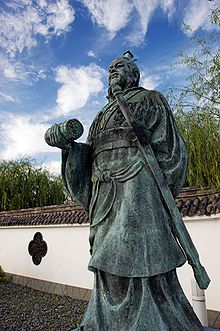
Sunday Tzu (孫子 Sūn Zǐ; c. 6th century BC) was a Chinese general, armed services strategist, and philosopher who lived in the Eastern Zhou period of ancient China. Sun Tzu is traditionally credited as the author of The Art of War, a widely influential work of armed forces strategy that has afflicted both Western and East Asian philosophy and military machine thinking. He is also known as Lord's day Wu (孫武; Sūn Wǔ), and Chang Qing (長卿; Cháng Qīng).
The Art of State of war [edit]

All men can see these tactics whereby I conquer, just what none can encounter is the strategy out of which victory is evolved.
Affiliate titles from Chow-Hou Wee (2003)
Chapter 1 · Item Cess and Planning [edit]
- 兵者,詭道也。故能而示之不能,用而示之不用,近而示之遠,遠而示之近,
- All warfare is based on deception. Hence, when we are able to assault, we must seem unable; when using our forces, we must appear inactive; when we are near, nosotros must make the enemy believe we are far away; when far away, we must brand him believe we are near.
- Variant translations
- A military functioning involves deception. Even though y'all are competent, appear to exist incompetent. Though constructive, appear to be ineffective.
- 實而備之,強而避之,怒而撓之,卑而驕之,佚而勞之,親而離之,出其不意,攻其不備。
- If your enemy is secure at all points, be prepared for him. If he is in superior forcefulness, evade him. If your opponent is temperamental, seek to irritate him. Pretend to be weak, that he may grow arrogant. If he is taking his ease, requite him no remainder. If his forces are united, carve up them. Attack him where he is unprepared, appear where y'all are not expected.
- Note: "If his forces are united, carve up them" is also interpreted: "If sovereign and subject are in accord, put partition between them."
- 亂而取之
- Hold out baits to entice the enemy. Feign disorder, and crush him.
- 卑則驕之
- Pretend inferiority and encourage his arrogance.
- 孫子曰:國之上下,死生之地,存亡之道,不可不察也。
- The art of state of war is of vital importance to the State. It is a affair of life and death, a route either to safety or to ruin. Hence it is a subject of inquiry which tin can on no account be neglected.
- 夫未戰而廟算勝者,得算多也;未戰而廟算不勝者,得算少也。
- The general who wins the battle makes many calculations in his temple before the battle is fought. The general who loses makes but few calculations beforehand.
- 將聽吾計,用之必勝,留之;將不聽吾計,用之必敗,去之;
- The general that hearkens to my counsel and acts upon it, will conquer: let such a i be retained in command! The general that hearkens non to my counsel nor acts upon it, will suffer defeat: — allow such a one be dismissed!
- 怒而撓之
- If your opponent is of quick-tempered temperament, seek to irritate him.
Chapter II · Waging State of war [edit]
- 故兵貴勝,不貴久。
- What is essential in war is victory, non prolonged operations.
- 近於師者貴賣,貴賣則百姓財竭
- Where the army is, prices are high; when prices ascension the wealth of the people is exhausted.
- 兵久而國利者,未之有也。
- In that location is no instance of a nation benefiting from prolonged warfare.
Chapter Three · Strategic Assail [edit]
- 上兵伐謀
- What is of supreme importance in war is to attack the enemy's strategy.
- 知彼知己,百戰不殆;不知彼而知己,一勝一負;不知彼,不知己,每戰必殆
- It is said that if you know your enemies and know yourself, you lot will not be imperiled in a hundred battles; if you do non know your enemies but do know yourself, y'all will win one and lose one; if you do non know your enemies nor yourself, you volition be imperiled in every single battle.
- Variant translations
- If you know others and know yourself, you volition not be imperiled in a hundred battles; if you lot do not know others simply know yourself, yous win 1 and lose one; if y'all do not know others and exercise non know yourself, you will be imperiled in every single battle.
- Know your enemy and know yourself, observe zippo in fear for 100 battles. Know yourself simply not your enemy, find level of loss and victory. Know not thy enemy nor yourself, wallow in defeat every time.
- Literal translation: Know [the] other, know [the] self, hundred battles without danger; not knowing [the] other but know [the] self, one win one loss; not knowing [the] other, non knowing [the] self, every boxing must [be] lost.
- 故用兵之法,十則圍之,五則攻之,倍則分之, 敵則能戰之,少則能守之,不若則能避之。
- Information technology is the rule in war, if ten times the enemy'southward force, surround them; if five times, assault them; if double, be able to divide them; if equal, engage them; if fewer, defend confronting them; if weaker, be able to avoid them.
- 是故百戰百勝,非善之善者也;不戰而屈人之兵,善之善者也。
- For to win i hundred victories in one hundred battles is not the acme of skill. To subdue the enemy without fighting is the acme of skill.
- Variant translations
- Hence to fight and conquer in all your battles is not supreme excellence; supreme excellence consists in breaking the enemy's resistance without fighting.
- The best victory is when the opponent surrenders of its own accordance before there are any actual hostilities... It is best to win without fighting.
- 古之所善戰者,勝於易勝者也。
- What the ancients called a clever fighter is one who not only wins, simply excels in winning with ease.
- 知可戰與不可戰者勝。
- He who knows when he can fight and when he cannot will be victorious.
- 以虞待不虞者勝。
- He who is prudent and lies in wait for an enemy who is not, will be victorious.
- 凡用兵之法,全國爲上;破國次之;全軍爲上,破軍次之;全旅爲上,破旅次之;全卒爲上,破卒次之;全伍爲上,破伍次之。
- In the practical fine art of war, the all-time thing of all is to accept the enemy's state whole and intact; to shatter and destroy it is non so practiced. So, also, information technology is better to recapture an army unabridged than to destroy information technology, to capture a regiment, a disengagement or a visitor entire than to destroy them.
- Variant translations
- It is all-time to keep one's ain state intact; to crush the enemy's state is only second best.
- 是故上攻伐謀
- Thus, what is of supreme importance in war is to assault the enemy'south strategy.
Affiliate IV · Disposition of the Regular army [edit]
- 是故勝兵先勝而後求戰,敗兵先戰而後求勝。
- Victorious warriors win first and and so go to war, while defeated warriors go to state of war start and then seek to win.
- Variant: Thus it is that in state of war the victorious strategist only seeks battle after the victory has been won, whereas he who is destined to defeat first fights and afterwards looks for victory.
- 見勝不過衆人之所識,非善之善者也。
- To see victory simply when information technology is within the ken of the common herd is not the acme of excellence.
- 守則不足,攻則有餘
- One defends when his strength is inadequate; he attacks when information technology is arable.
- 孫子曰:昔之善戰者,先爲不可勝,以待敵之可勝,不可勝在己,可勝在敵。故善戰者,能爲不可勝,不能使敵必可勝。故曰:勝可知,而不可爲。
- Sunzi said: The good fighters of old first put themselves across the possibility of defeat, and then waited for an opportunity of defeating the enemy. To secure ourselves against defeat lies in our own hands, merely the opportunity of defeating the enemy is provided by the enemy himself. Thus the practiced fighter is able to secure himself against defeat, but cannot make certain of defeating the enemy.
- Translation by Lionel Giles
Chapter V · Forces [edit]
- 治眾如治寡,分數是也。
- Management of many is the same as management of few. It is a thing of organization.
- 積水之激,至於漂石者,勢也。鷙鳥之疾,至於毀折者,節也。
- When torrential h2o tosses boulders, it is because of its momentum. When the strike of a hawk breaks the body of its prey, it is because of timing.
- 鷙鳥之疾,至於毀折者,節也。
- The quality of decision is like the well-timed swoop of a falcon which enables it to strike and destroy its victim.
- 故善戰者,求之於勢,不責於人。
- A skilled commander seeks victory from the situation and does not demand it of his subordinates.
- Variant: The skillful in battle seeks his victory from strategic reward and does not demand it from his men.
Affiliate Six · Weaknesses and Strengths [edit]
- 微乎微乎,至於無形;神乎神乎,至於無聲;故能為敵之司命。
- Exist extremely subtle, even to the bespeak of formlessness. Exist extremely mysterious, even to the point of soundlessness. Thereby you lot tin can exist the director of the opponent's fate.
- Alternative translation: Subtle and insubstantial, the expert leaves no trace; divinely mysterious, he is inaudible. Thus he is master of his enemy'southward fate.'
- Alternative translation: O divine art of subtlety and secrecy! Through you we acquire to exist invisible, through you inaudible and hence we can hold the enemy's fate in our hands.
- 人皆知我所以勝之形,而莫知吾所以制勝之形。
- All men tin meet these tactics whereby I conquer, but what none can see is the strategy out of which victory is evolved.
- 故形兵之極,至於無形,無形,則深間不能窺,上智不能謀。
- The ultimate in disposing one's troops is to be without ascertainable shape. And then the most penetrating spies cannot pry in nor can the wise lay plans against yous.
- 故善戰者,至人而不至於人。
- And therefore those skilled in war bring the enemy to the field of boxing and are not brought at that place by him.
- 故敵逸能勞之,飽能飢之,安能動之。出其所不趨,趨其所不意。
- When the enemy is at ease, exist able to weary him; when well fed, to starve him; when at rest, to make him move. Appear at places to which he must hasten; motility swiftly where he does not look you.
- H2o shapes its form according to the nature of the basis over which it flows; the soldier works out his victory in relation to the foe whom he is facing. Therefore, only as h2o retains no constant shape, so in warfare there are no abiding conditions. He who can modify his tactics in relation to his opponent and thereby succeed in winning, may be called a heaven-born helm.
- Lionel Giles translation
Chapter Vii · Military Maneuvers [edit]
- 故其疾如風,其徐如林,侵掠如火,不動如山,難知如陰,動如雷霆。
- Fūrinkazan: 故に其の疾きこと風の如く、其の徐かなること林の如く、侵掠すること火の如く、動かざること山の如く、知りがたきこと陰の如く、動くこと雷霆の如し。
- Let your rapidity be that of the air current, your gentleness that of the forest. In raiding and plundering be like fire, exist immovable like a mountain. Be as hard to know as the shadow and Move every bit fast as lightning.
- as swift as wind, as gentle every bit forest, as tearing as burn down, equally unshakable as mount.
- 圍師必闕
- To a surrounded enemy, you must leave a way of escape.
Chapter Viii · Variations and Adaptability [edit]
- 故用兵之法,無恃其不來,恃吾有以待之;無恃其不攻,恃吾有所不可攻也。
- The fine art of war teaches us to rely non on the likelihood of the enemy'southward not coming, but on our own readiness to receive him; not on the gamble of his not attacking, but rather on the fact that we accept made our position unassailable.
- Translation by Lionel Giles
Chapter Nine · Movement and Evolution of Troops [edit]
- 數賞者,窘也;數罰者,困也;
- Too frequent rewards signal that the full general is at the terminate of his resources; too frequent punishments that he is in acute distress.
- In war, numbers alone confer no reward. Exercise not advance relying on sheer war machine power.
- 令素行以敎其民,則民服。令不素行以敎其民,則民不服。令素行者,與民相得也。
- A leader leads by example not by force.
Chapter X · Terrain [edit]
- 將弱不嚴,敎道不明,將之過也。
- If words of control are not clear and distinct, if orders are not thoroughly understood, the general is to blame. Just if his orders are clear, and the soldiers all the same disobey, then information technology is the fault of their officers.
- 故戰道必勝,主曰無戰,必戰可也;戰道不勝,主曰必戰,無戰可也;
- If fighting is sure to upshot in victory, then y'all must fight, even though the ruler foreclose it; if fighting volition non result in victory, and then y'all must not fight fifty-fifty at the ruler'due south bidding.
- 進不邀功,退不避罪,唯人是保,而利合於主,國之寶也。
- The general who advances without coveting fame and retreats without fearing disgrace, whose but thought is to protect his country and do expert service for his sovereign, is the jewel of the kingdom.
- 視卒如愛子,故可與之俱死。
- Treat your men as you would your own dear sons. And they will follow yous into the deepest valley.
Affiliate 11 · The Nine Battlegrounds [edit]
- 吾士無余財,非惡貨也。無余命,非惡壽也。
- If our soldiers are not overburdened with coin, it is non because they accept a distaste for riches; if their lives are not disproportionately long, it is non because they are disinclined to longevity.
- 兵之情主速,乘敵所不及,由不虞之途,攻其所不備也。
- Speed is the essence of war. Have reward of the enemy's unpreparedness; travel by unexpected routes and strike him where he has taken no precautions.
- 施無法之賞,懸無政之令。犯三軍之眾,若使一人。
- Bequeath rewards without respect to customary practice; publish orders without respect to precedent. Thus y'all may use the unabridged army as yous would one man.
Chapter XII · Attacking with Burn [edit]
- 非利不動,非得不用,非危不戰。主不可以怒而興師,將不可以慍而致戰;合于利而動,不合于利而止。怒可以復喜,慍可以復悅,亡國不可以復存,死者不可以復生。故明君慎之,良將警之,此安國全軍之道也。
- Motility non unless you see an advantage; utilise non your troops unless there is something to be gained; fight not unless the position is critical. No ruler should put troops into the field just to gratify his own spleen; no general should fight a battle simply out of pique. If information technology is to your advantage, brand a forward move; if not, stay where you are. Anger may in time alter to gladness; vexation may be succeeded by content. But a kingdom that has once been destroyed tin never come over again into being; nor can the dead ever be brought back to life. Hence the enlightened ruler is heedful, and the skilful general total of caution. This is the manner to keep a land at peace and an army intact.
- Translation by Lionel Giles
Chapter Xiii · Intelligence and Espionage [edit]
- 敵間之來間我者,因而利之,導而捨之,故反間可得而用也;
- It is essential to seek out enemy agents who take come up to conduct espionage confronting you and to bribe them to serve you. Give them instructions and intendance for them. Thus doubled agents are recruited and used.
- 故明君賢將,所以動而勝人,成功出於衆者,先知也。
- Now the reason the enlightened prince and the wise general conquer the enemy whenever they motion and their achievements surpass those of ordinary men is foreknowledge.
- 故三軍之事,莫親於間,賞莫厚於間,事莫密於間
- Of all those in the army close to the commander none is more intimate than the hugger-mugger agent; of all rewards none more than liberal than those given to secret agents; of all matters none is more confidential than those relating to hugger-mugger operations.
- 此(譯注:用間)兵之要,三軍之所恃而動也。
- Secret operations are essential in state of war; upon them the army relies to make its every move.
Disputed [edit]
- Build your opponent a gilded span to retreat across.
- This has appeared every bit a variant of Lord's day Tzu's assertion to "leave a manner of escape." Tu Mu, commenting on Sun Tzu, advises, "Show him there is a road to rubber..." Ch. seven; it has also recently appeared on the internet attributed to Scipio Africanus, merely without citation.
- Engage people with what they expect; it is what they are able to discern and confirms their projections. It settles them into predictable patterns of response, occupying their minds while you wait for the extraordinary moment — that which they cannot anticipate.
- Victory is reserved for those who are willing to pay its price.
- Attributed to Dominicus Tzu in multiple books and internet sites, just this text does not appear in The Art of War and seems to be a more recent creation.
Misattributed [edit]
- Keep your friends close, and your enemies closer.
- This has often been attributed to Dominicus Tzu and sometimes to Petrarch. It comes most direct from a line spoken by Michael Corleone in The Godfather Part II (1974), written by Mario Puzo and Francis Ford Coppola:
- My begetter taught me many things hither. He taught me in this room. He taught me: keep your friends close only your enemies closer.
- My begetter taught me many things hither. He taught me in this room. He taught me: keep your friends close only your enemies closer.
- Niccolò Machiavelli, who is also sometimes credited, wrote on the subject in The Prince:
- Information technology is easier for the prince to brand friends of those men who were contented nether the sometime regime, and are therefore his enemies, than of those who, being discontented with information technology, were favourable to him and encouraged him to seize it.
- There are also some attributions of a relatable annotate to Genghis Khan:
- To know your Enemy, you must become your Enemy.
- This is sometimes attributed to Dominicus Tzu in combination with the higher up quote, besides as solitary, but information technology too has not been sourced to any published translation of The Fine art of War, though information technology is similar in concept to his famous statement in Ch. 3 : "It is said that if yous know your enemies and know yourself, you volition non be imperiled in a hundred battles..."
- To know your Enemy, you must become your Enemy.
- This has often been attributed to Dominicus Tzu and sometimes to Petrarch. It comes most direct from a line spoken by Michael Corleone in The Godfather Part II (1974), written by Mario Puzo and Francis Ford Coppola:
- Strategy without tactics is the slowest road to victory. Tactics without strategy is the racket before defeat.
- Probably apocryphal. This quotation does not appear in whatsoever impress translation of Sunday Tzu. The commencement citation in Google Books is from 2002; no commendation in Google Books occurs in a translation of Dominicus Tzu.
- The true objective of war is peace.
- This attributed to Sun Tzu and his book The Art of War. Actually James Clavell's foreword in The Art of War states, "'the true object of state of war is peace.'" Therefore the quote is stated past James Clavell, but the true origin of Clavell'southward quotation is unclear. Nonetheless the essence of the quote, that a long war exhausts a state and therefore ultimately seeking peace is in the interest of the warring state, is true, as Sun Tzu in Chapter Two Waging Wars says that "There is no instance of a state having benefited from prolonged warfare. It is but ane who is thoroughly acquainted with the evils of war that tin can thoroughly empathise the assisting way of carrying information technology on." This has been interpreted past Lionel Giles as "Just one who knows the disastrous effects of a long war tin realize the supreme importance of rapidity in bringing information technology to a close."
- Dr. Hiroshi Hatanaka, President of Kobe College, Nishinomiya, Hyōgo, Nihon is recorded as maxim "the real objective of state of war is peace" in Pacific Stars and Stripes Ryukyu Edition, Tokyo, Japan (10 Feb 1949), Page 2, Column ii.
- Opportunities multiply as they are seized.
- Sunday Tzu amongst many other armed services thinkers and leaders believed in fate and determination from the correct application of theory, the land of the opponent'southward and one'southward own power, and a lawmaking for the general and a code for the soldier to follow, rather than the Machiavellian blazon of intuition that evokes an evolution of opportunism that brought slap-up historical consequences as it dominated over the classical and medieval upstanding doctrines. Thus this argument is contrary to Sun Tzu principles. Nevertheless, there is a possible relation to the quote: Quickness is the essence of the war.
- In peace, set for war. In war, prepare for peace.
- Sometimes erroneously prepended to the opening line "The fine art of war is of vital importance to the State", but appears to be a variation of the Roman motto "Si vis pacem, para bellum". It'south not clear who first misattributed this phrase to Sunday Tzu. The earliest appearance of the phrase in Google Books is 1920, when information technology appeared in a pharmaceutical journal, but no attribution was given then.
- Fearfulness is the truthful enemy, the only enemy.
- Attributed implicitly to Sun Tzu by "William Riker" in the episode The Last Outpost of the Television receiver programme Star Trek: The Next Generation, just no source for this quote predates the episode's airing in 1987.
Quotes about Dominicus Tzu [edit]
- 吳王曰:「將軍罷休就舍,寡人不願下觀。」孫子曰:「王徒好其言,不能用其實。」於是闔廬知孫子能用兵,卒以為將。西破彊楚,入郢,北威齊晉,顯名諸侯,孫子與有力焉。
- The King of Wu said,"Enough, general. Retire to your hostel, We do non wish to come up downwardly and discover." Lord's day Tzu said, "The male monarch only loves the words, he cannot brand apply of the reality." After this, Ho-lu knew that Sun Tzu could command troops and in the stop appointed him commander. [Later when Wu] defeated mighty Ch'u to its west and entered its capital Ying awed Ch'i and Mentum to its north and spread its fame amid the feudal lords, information technology was due in office to Sun Tzu.
- translated by Tsai-fa Cheng, Zongli Lu, William H. Nienhauser, Jr., and Robert Reynolds, in The Grand Scribe's Records, edited by William H. Nienhauser, Jr.
- Sima Qian, Records of the One thousand Historian, 孫子吳起列傳
- The King of Wu said,"Enough, general. Retire to your hostel, We do non wish to come up downwardly and discover." Lord's day Tzu said, "The male monarch only loves the words, he cannot brand apply of the reality." After this, Ho-lu knew that Sun Tzu could command troops and in the stop appointed him commander. [Later when Wu] defeated mighty Ch'u to its west and entered its capital Ying awed Ch'i and Mentum to its north and spread its fame amid the feudal lords, information technology was due in office to Sun Tzu.
- 諸將效首虜,(休)畢賀,因問信曰:「兵法右倍山陵,前左水澤,今者將軍令臣等反背水陳,曰破趙會食,臣等不服。然竟以勝,此何術也?」信曰:「此在兵法,顧諸君不察耳。兵法不曰『陷之死地而後生,置之亡地而後存』?且信非得素拊循士大夫也,此所謂『驅市人而戰之』,其勢非置之死地,使人人自為戰;今予之生地,皆走,寧尚可得而用之乎!」諸將皆服曰:「善。非臣所及也。」
- Afterwards the diverse commanders presented the heads [of the enemies] and the captives, they all offered their congratulations. They took the reward to enquire [Han] Hsin and said, "The Art of State of war says 'keep the hills to your right and your back; keep the waters to the front or at your left.'' At present y'all, General, on the contrary ordered your subjects to draw up in array with our backs confronting the river and said, 'We will defeat Chao and feast together.' Your servants were non convinced. Even so, we won with this in the end. What strategy was this?" [Han] Hsin said, "This is in The Art of War, however, yous gentlemen did not detect information technology. Doesn't The Art of War say 'They will survive after being trapped in a fatal situation and volition live on after being placed in a hopeless position? Furthermore, I do not have well-trained officers. This is what is called 'Bulldoze the street rabble and have them fight.' The circumstances were that I had to put them in a fatal situation and fabricated every person fight for his life. If I had put them in a safe situation, they would have had already run away. How could they accept been held and employed?" The various commanders were all convinced and said, "Well put. It is of [a level] that we could not reach."
- translation past Wang Jing, in The Grand Scribe'south Records, edited by William H. Nienhauser, Jr.
- On Boxing of Jingxing
- Sima Qian, Records of the Grand Historian, 淮陰侯列傳
- Afterwards the diverse commanders presented the heads [of the enemies] and the captives, they all offered their congratulations. They took the reward to enquire [Han] Hsin and said, "The Art of State of war says 'keep the hills to your right and your back; keep the waters to the front or at your left.'' At present y'all, General, on the contrary ordered your subjects to draw up in array with our backs confronting the river and said, 'We will defeat Chao and feast together.' Your servants were non convinced. Even so, we won with this in the end. What strategy was this?" [Han] Hsin said, "This is in The Art of War, however, yous gentlemen did not detect information technology. Doesn't The Art of War say 'They will survive after being trapped in a fatal situation and volition live on after being placed in a hopeless position? Furthermore, I do not have well-trained officers. This is what is called 'Bulldoze the street rabble and have them fight.' The circumstances were that I had to put them in a fatal situation and fabricated every person fight for his life. If I had put them in a safe situation, they would have had already run away. How could they accept been held and employed?" The various commanders were all convinced and said, "Well put. It is of [a level] that we could not reach."
- Sun Tzu's success teaches us that a successful full general is one who fully calculates his approach and plans to fight in a battle. Nonetheless, the average reader is non able to identify Sun Tzu'southward teachings on a deeper or philosophical level. This is my reason for writing and exegeses on the Fine art of War.
- Cao Cao, 《孫子略解》 Concise Explanations of Sunday Tzu
- The one thing missing from The Art of War is love, ... any sense of altruism, any sense of loving your neighbor. It's simply a[bout] how to take advantage of your neighbour, how to triumph over your neighbour, how to manipulate your neighbor. I'one thousand pitiful... It's a very nasty book. How to employ your spies — that affiliate thirteen on spies — is chilling. The whole book — of course it's very clever, and of course a lot of it is very true, and of class nosotros can get through life treating people in that way if you want to, but I don't happen to believe that'southward the all-time style to become. ... The Lúnyǔ [Analects of Confucius] is a superior book to Sūnzi bīngfǎ [The Art of War] because the Lúnyǔ talks near morality, talks nigh caring for your fellow human being; after all, the whole thought of ren ... doesn't come in Sūnzi bīngfǎ at all. Sūnzi bīngfǎ is: how to apply your friends and neighbors in society to get the better of them. That doesn't make me feel good. I'k an quondam-fashioned kind of guy, and I believe in existence nice to people whenever I tin. ... Y'all don't get out of your way like Sun Tzu to manipulate everybody including your friends. For me, Sūnzi bīngfǎ is the night side of Chinese culture. It'due south the night side. And, I know it's there. And there's a nighttime side to Western culture too. And, therefore, it's important to be aware of it, but not to be corrupted past information technology. Not to exist polluted past it. Because information technology is a very powerfully-polluting picayune volume. Very nasty little volume. Allow'south not pretend otherwise.
- John Minford, Lecture on Culture and Translation at Hang Seng Management College (20 February 2016)
See besides [edit]
| Social and political philosophy | ||
| Philosophers | Ambedkar • Arendt • Aristotle • Augustine • Aurobindo • Aquinas • Aron • Averroes • Badiou • Bakunin • Baudrillard • Bauman • Bentham • Berlin • Shush • Butler • Camus • Chanakya • Chomsky • Cicero • Comte • Confucius • De Beauvoir • Debord • Du Bois • Durkheim • Emerson • Engels • Fanon • Foucault • Fourier • Franklin • Gandhi • Gentile • Gramsci • Grotius • Habermas • Han Fei • Hayek • Hegel • Heidegger • Hobbes • Hume • Jefferson • Kant • Kierkegaard • Kirk • Kropotkin • Laozi • Leibniz • Lenin • Locke • Luxemburg • Machiavelli • Maistre • Malebranche • Mao • Marcuse • Maritain • Marx • Mencius • Michels • Mill • Mises • Montesquieu • Mozi • Muhammad • Negri • Niebuhr • Nietzsche • Nozick • Oakeshott • Ortega • Paine • Pareto • Plato • Polanyi • Popper • Radhakrishnan • Rand • Rawls • Renan • Rothbard • Rousseau • Royce • Russell • Sade • Santayana • Sartre • Schmitt • Scruton • Searle • Skinner • Smith • Socrates • Sombart • Sowell • Spencer • Spengler • Spinoza • Stirner • Strauss • Sun • Dominicus Tzu • Taine • Taylor • Thucydides • Thoreau • Tocqueville • Vivekananda • Voltaire • Walzer • Weber • Žižek | |
| Social theories | Riot • Authoritarianism • Collectivism • Communism • Confucianism • Conservatism • Fascism • Individualism • Liberalism • Libertarianism • Republicanism • Social constructionism • Socialism • Utilitarianism | |
| Concepts | Civil defiance • Justice • Law • Peace • Belongings • Revolution • Rights • Social contract • Society • Tyranny • War | |
| Forms of rule | Elite • Bureaucracy • Democracy • Meritocracy • Monarchy • Plutocracy • Technocracy | |
External links [edit]


- Dominicus Zi'southward The Art of War text translated by Lionel Giles
- Translation in Simplified Chinese and English - Chinese Wiki
- Gratuitous eBook of The Art of War translated by Lionel Giles (1910) at Project Gutenberg
Source: https://en.wikiquote.org/wiki/Sun_Tzu
0 Response to "Keep Your Friends Close and Your Enemies Closer Quote Art of War"
Post a Comment